
Tropical plants bring lush greenery and exotic beauty to indoor spaces, but maintaining their health requires careful attention to environmental conditions. One of the most critical factors for these species is humidity, as they originate from rainforests and other moisture-rich habitats. Many houseplant enthusiasts struggle to replicate these conditions in typical home environments, where central heating and air conditioning can create dry air that stresses tropical foliage. Pebble trays have emerged as a popular, low-cost solution to this challenge, offering a simple method to increase localised humidity around plants. This technique involves placing plants on trays filled with water and pebbles, creating a microclimate that mimics their natural habitat. Understanding how to properly implement and maintain this system can significantly improve plant health and vitality.
Understanding the Importance of Humidity for Tropical Plants
Why humidity matters for plant physiology
Tropical plants have evolved in environments where relative humidity typically ranges between 60% and 90%, far exceeding the 30% to 50% commonly found in most homes. These species possess physiological adaptations that depend on high moisture levels in the air. Their leaves often feature larger stomata and thinner cuticles compared to plants from arid regions, making them particularly vulnerable to moisture loss through transpiration when humidity drops. Without adequate atmospheric moisture, these plants cannot maintain proper cellular function, leading to visible stress symptoms and potential long-term damage.
Consequences of insufficient humidity
When tropical plants experience prolonged exposure to low humidity, several problems emerge that compromise their health and appearance. The most immediate signs include:
- Brown, crispy leaf edges and tips
- Yellowing or dropping leaves
- Stunted growth and smaller new foliage
- Increased susceptibility to pest infestations, particularly spider mites
- Wilting despite adequate watering
These symptoms occur because plants lose water faster than their roots can absorb it, creating a deficit that affects all cellular processes. Photosynthesis becomes less efficient, nutrient transport slows, and the plant diverts energy from growth to survival mechanisms.
Optimal humidity levels for common tropical species
| Plant Type | Ideal Humidity Range | Minimum Tolerance |
|---|---|---|
| Ferns | 70-80% | 50% |
| Calatheas | 60-75% | 50% |
| Monsteras | 60-70% | 40% |
| Orchids | 50-70% | 40% |
| Philodendrons | 60-75% | 40% |
Understanding these requirements helps determine whether humidity-boosting interventions like pebble trays are necessary for specific plants. With this foundation established, examining the mechanics of pebble trays reveals how this simple tool addresses these humidity needs.
What Is a Pebble Tray and How Does It Work ?
Basic construction and components
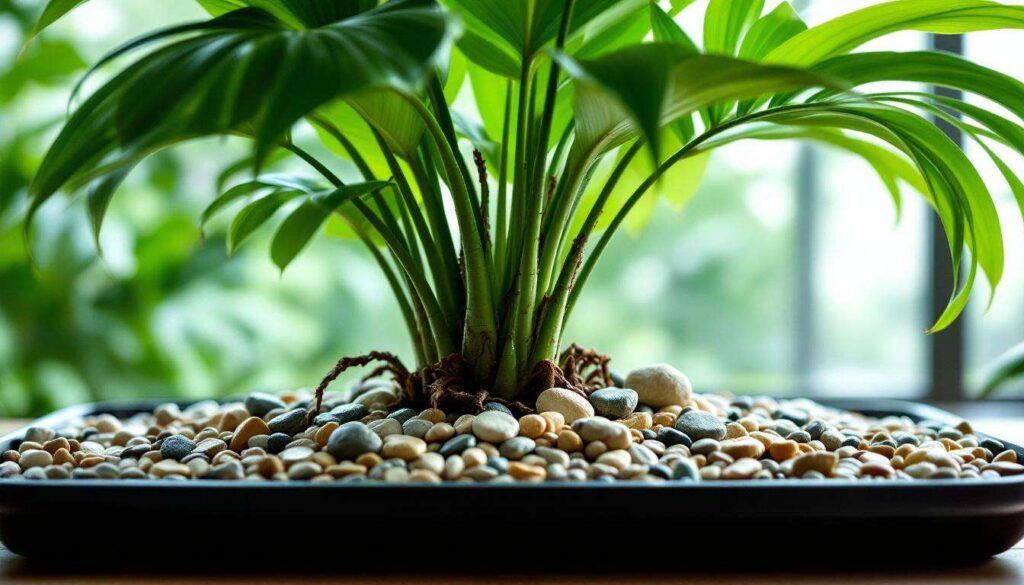
A pebble tray consists of three essential elements: a shallow waterproof container, a layer of pebbles or stones, and water that sits below the top of the pebble layer. The container can be any shallow dish, saucer, or tray made from plastic, ceramic, or metal. The pebbles should be large enough to create air spaces and prevent the plant pot from sitting directly in water. Common materials include decorative river stones, aquarium gravel, or even marbles. The water level should reach approximately halfway up the pebbles, ensuring the bottom of the plant container remains above the waterline.
The evaporation mechanism
The effectiveness of pebble trays relies on passive evaporation, a continuous process that increases moisture in the air immediately surrounding the plant. As water evaporates from the tray surface, it rises and creates a localised zone of higher humidity around the foliage. This process accelerates in warmer conditions and slows in cooler temperatures. The pebbles serve multiple functions: they increase the surface area for evaporation, prevent the pot from sitting in water which could cause root rot, and allow air circulation beneath the container. The microclimate created extends approximately 30 to 50 centimetres around the plant, providing targeted humidity where it matters most.
Scientific principles behind humidity zones
The humidity created by pebble trays follows basic physics principles. Water molecules transition from liquid to vapour state, absorbing energy from the surrounding environment. This vapour remains concentrated near the source before dispersing into the broader room atmosphere. The effect is most pronounced in still air conditions, as air movement quickly disperses the moisture. Research suggests that pebble trays can increase localised humidity by 5% to 15%, depending on factors such as:
- Room temperature and baseline humidity
- Tray size relative to plant size
- Air circulation patterns
- Water surface area exposed
While modest, this increase can make a meaningful difference for sensitive tropical species. These operational principles demonstrate the practical advantages this method offers to plant care routines.
The Benefits of Pebble Trays for Humidity
Cost-effectiveness and accessibility
Compared to electric humidifiers or misting systems, pebble trays represent an economical solution that requires no electricity or complex equipment. The materials are readily available at garden centres, home improvement stores, or can be repurposed from household items. Initial setup costs typically range from minimal to moderate, depending on aesthetic preferences. Once assembled, ongoing expenses are virtually non-existent, requiring only periodic water refills. This makes the method particularly appealing for hobbyists maintaining multiple plants or those experimenting with tropical species for the first time.
Low maintenance requirements
Pebble trays demand minimal attention compared to other humidity solutions. The primary maintenance task involves monitoring water levels and refilling as needed, typically every few days to a week depending on environmental conditions. Unlike humidifiers that require filter changes, cleaning schedules, and potential repairs, pebble trays function indefinitely with basic care. Occasional rinsing of the pebbles prevents algae buildup and mineral deposits, a task that takes only minutes every few weeks.
Additional advantages for plant health
Beyond humidity provision, pebble trays offer supplementary benefits that contribute to overall plant wellness:
- Improved drainage by elevating pots and preventing water accumulation
- Visual cues for watering needs, as evaporation rates correlate with plant transpiration
- Protection for surfaces from water damage or staining
- Aesthetic enhancement through decorative pebble choices
- Flexibility to group multiple plants on larger trays for collective humidity benefits
These combined advantages make pebble trays a versatile tool in any plant care arsenal. Implementing this system correctly ensures these benefits are fully realised in practice.
How to Use a Pebble Tray to Optimise Plant Growth
Step-by-step setup instructions
Creating an effective pebble tray system requires attention to detail during assembly. Begin by selecting a tray that extends at least 5 to 10 centimetres beyond the plant pot diameter on all sides. Clean the container thoroughly to remove any residues or contaminants. Add a layer of pebbles approximately 2 to 4 centimetres deep, ensuring even distribution. Pour water into the tray until it reaches just below the top of the pebbles, leaving the upper surfaces dry. Place the plant pot on the pebbles, verifying that the container bottom does not touch the water. Position the entire assembly in the plant’s designated location, considering light requirements and air circulation patterns.
Maintenance and water management
Consistent monitoring ensures the pebble tray functions optimally throughout the year. Check water levels every two to three days, particularly during warmer months when evaporation rates increase. Refill promptly when the water level drops below halfway down the pebbles. Every two to four weeks, empty the tray completely and rinse both the container and pebbles with clean water to remove mineral buildup and prevent algae growth. For hard water areas, consider using distilled or filtered water to minimise white residue formation. During winter months when heating systems reduce indoor humidity further, increase monitoring frequency to maintain adequate moisture levels.
Strategic placement for maximum effectiveness
The positioning of pebble trays significantly influences their humidity-boosting capacity. Place trays in locations with moderate air circulation rather than directly beside heating vents or in stagnant corners. Grouping multiple plants on a single large tray creates a collective microclimate where transpiration from all plants combines with tray evaporation for enhanced humidity. Avoid positioning trays in direct sunlight, as this accelerates evaporation excessively and may encourage algae growth. Consider the surrounding environment: rooms with naturally higher humidity like bathrooms or kitchens require less supplementation than living areas with constant heating or cooling.
Seasonal adjustments
Adapting pebble tray management to seasonal changes optimises year-round plant health. During summer, increased temperatures and plant growth rates demand more frequent water refills and potentially larger tray sizes. Winter presents the greatest challenge, as central heating dramatically reduces indoor humidity. Supplement pebble trays with additional methods during this period, and ensure water levels remain consistent despite lower evaporation rates. Spring and autumn typically require moderate attention, though monitoring remains essential as weather fluctuations affect indoor conditions unpredictably.
While pebble trays offer numerous advantages, understanding their limitations and potential drawbacks ensures they are used appropriately and safely.
Precautions to Take with Pebble Trays
Preventing root rot and overwatering
The most critical precaution involves ensuring plant pots never sit directly in the water reservoir. Even brief contact can lead to waterlogged soil, which suffocates roots and creates conditions for fungal diseases. Always verify that pebbles elevate the pot adequately, and check regularly that water levels have not risen to touch the container bottom. For plants in pots without drainage holes, extra vigilance is essential, as excess moisture has nowhere to escape. Consider using pot feet or additional pebble layers for heavy plants that may sink over time.
Managing algae and bacterial growth
Standing water inevitably encourages microbial growth, particularly in warm conditions with adequate light. While generally harmless to plants, algae creates unsightly green films and unpleasant odours. Prevent this by:
- Changing water completely every one to two weeks
- Cleaning pebbles and trays with diluted hydrogen peroxide or vinegar solution
- Keeping trays out of direct sunlight
- Adding a small piece of activated charcoal to the water
- Ensuring adequate air circulation around the tray
Addressing mineral buildup and water quality
Hard water leaves white crusty deposits on pebbles and tray surfaces as minerals concentrate through evaporation. These deposits are primarily calcium and magnesium salts, which can accumulate to unsightly levels. Regular cleaning removes these residues, but switching to distilled or rainwater prevents buildup more effectively. If using tap water, allow it to sit for 24 hours before adding to trays, permitting chlorine to dissipate and reducing potential leaf damage from splashing.
Pest considerations
Moist environments can attract certain pests, particularly fungus gnats that breed in damp conditions. While pebble trays themselves rarely harbour these insects, the combination of moist soil and humid air creates ideal conditions. Monitor plants regularly for signs of infestation, and ensure soil dries appropriately between waterings. The water in pebble trays should remain clean and clear, as stagnant, dirty water attracts more pests than fresh reserves.
For situations where pebble trays prove insufficient or impractical, several alternative methods can supplement or replace this humidity solution.
Alternatives to Pebble Trays for Maintaining Humidity
Electric humidifiers
For comprehensive humidity control, electric humidifiers offer the most effective solution, capable of raising room-wide humidity levels significantly. Cool mist and warm mist varieties both function well for plants, with cool mist models generally preferred for safety and energy efficiency. These devices benefit entire plant collections simultaneously and provide precise humidity control through adjustable settings. However, they require regular maintenance including filter replacements, daily water refills, and thorough cleaning to prevent bacterial growth. Running costs include electricity consumption and replacement parts, making them more expensive than passive methods.
Misting and foliar spraying
Direct misting of plant leaves provides temporary humidity increases and removes dust from foliage. Use a fine-mist spray bottle filled with room-temperature water, applying in the morning to allow leaves to dry before evening. While popular, this method offers only brief humidity boosts lasting minutes rather than hours, making it supplementary rather than primary. Excessive misting can encourage fungal diseases, particularly on plants with fuzzy leaves or those prone to powdery mildew. Reserve this technique for plants that specifically benefit from foliar moisture, such as certain orchids and bromeliads.
Grouping plants together
Creating plant clusters leverages collective transpiration to raise localised humidity naturally. As each plant releases moisture through its leaves, the combined effect creates a shared microclimate that benefits all members of the group. This method works particularly well when combining plants with similar care requirements, ensuring compatible watering and light needs. Position plants close enough to share humidity zones but with adequate spacing for air circulation to prevent fungal issues. This approach costs nothing and provides aesthetic benefits through attractive plant arrangements.
Bathroom and kitchen placement
Rooms with naturally higher humidity from regular water use provide ideal environments for tropical plants without additional interventions. Bathrooms offer steam from showers and baths, while kitchens generate moisture from cooking activities. Ensure adequate light availability in these spaces, as humidity alone cannot compensate for insufficient illumination. Consider the specific needs of each plant species, as some tolerate lower light better than others.
Terrariums and enclosed growing environments
For humidity-demanding species like certain ferns and carnivorous plants, enclosed containers create self-sustaining high-humidity environments. Glass terrariums, cloches, or repurposed aquariums trap moisture from soil evaporation and plant transpiration, maintaining near-constant humidity levels. These systems require minimal intervention once established but demand careful plant selection to avoid overcrowding and ensure compatible growth rates. Ventilation remains important to prevent excessive moisture buildup that encourages rot and fungal diseases.
Maintaining appropriate humidity for tropical houseplants need not be complicated or expensive. Pebble trays offer an accessible entry point for plant enthusiasts seeking to improve growing conditions without significant investment. By understanding the principles of evaporation, implementing proper setup and maintenance routines, and recognising when alternative methods may be necessary, anyone can create environments where tropical species thrive. The combination of correct humidity levels with appropriate watering, lighting, and feeding schedules forms the foundation of successful indoor plant cultivation, transforming living spaces into verdant sanctuaries that bring nature indoors.